
“You should automate that” is advice every small business owner has heard, usually about a different task each time, usually from someone who won’t be the one maintaining the automation. The instinct to automate is good. The instinct to automate the thing in front of you right now is how people end up with three half-built workflows that each break in their own special way.
Automation is leverage, and leverage applied at the wrong point makes the wrong thing bigger. The skill isn’t building automations, the tools make that easy now. The skill is choosing what to automate first, and what to leave alone. This post is a method for that choice.
Don’t ask “what can I automate.” Ask “what is costing me.”
The wrong starting question is “what’s possible.” Almost anything is possible, which is exactly why “what’s possible” leads nowhere useful. The right starting question is “what repeatable thing is costing me time, money, or mistakes right now?”
So before you open any tool, make a list. Every repeatable task in your business, written down plainly: lead intake, quoting, scheduling, the work itself, invoicing, payment chasing, follow-up. You can’t choose well from a list you haven’t made.
Score each task on three things
For every task on the list, give it a quick gut score on three dimensions:
- Frequency. Does it happen many times a week, or once a quarter?
- Sameness. Does it look identical every time, or does each instance need judgment?
- Pain. Is it tedious, error-prone, or a known bottleneck, or is it fine?
The best first automation is high frequency, high sameness, high pain. Something you do constantly, that’s nearly identical each time, and that you dread or keep getting slightly wrong. That’s the task that pays you back.
The worst first automation is the opposite, and it’s a trap because it’s often the most interesting one. A clever workflow for a rare, judgment-heavy task is a fun build and a poor investment, it saves an hour a year and breaks in ways you only discover months later.
Automate the boring back end first
Here’s the counterintuitive part. Most owners want to automate the exciting front end, lead capture, fancy intake forms, marketing. Resist that. The front of your business is where every customer is a slightly different human needing a slightly different response. High variability. Bad first target.
The back end, invoicing, payment reminders, appointment confirmations, follow-up requests, is where the work is repetitive, the variation is low, and the pain is real and recurring. That’s where to start. The boring end is the profitable end.
A reliable first automation for a lot of service businesses is the overdue-invoice reminder: it fires on a fixed schedule, the message barely changes, and the manual version is a chore everyone puts off. High frequency, high sameness, high pain, the textbook candidate.
The four mistakes that waste the effort
Once you’ve picked the task, four mistakes turn a good idea into a maintenance headache:
- Automating before standardizing. If the manual version is done three different ways, the automation will enforce one and break the other two. Agree on one way first, then automate that.
- Building the perfect version first. The elegant ten-step workflow takes weeks to build and breaks on the edge case nobody saw. Build the rough three-step version, run it for two weeks, and let the real edge cases reveal themselves before you polish.
- Skipping the human gate. Keep a person in the loop for anything involving judgment or money leaving your account, at least until you trust it. A daily summary email you glance at beats a silent process you’ve stopped watching.
- No monitoring. An unwatched automation is one that fails quietly. You need to know within a day if it stopped working, or you’ll find out from an angry customer instead.
Use the simplest tool that works
Reach for the least powerful tool that solves the problem. A lot of “automation” is just a setting you haven’t turned on yet:
- Built-in features first. Recurring invoices, automatic appointment confirmations, email templates and filters, your existing tools probably already do more than you’ve set up.
- No-code connectors next. When you need two tools to talk to each other, a connector platform handles it without code. Start on a cheap plan; you’ll rarely outgrow it.
- Custom code last. Most small service businesses never need this. If you do, you’ll know, because the simpler tiers will have visibly failed first.
The order, in one list
- List every repeatable task in the business.
- Score each on frequency, sameness, and pain.
- Pick the highest-scoring task, usually a boring back-end one.
- Standardize the manual version before building.
- Build the rough version, keep a human gate, monitor it.
- Only then move to the next task on the list.
The owner who automates well isn’t the one with the most automations. It’s the one who automated the right three things and left the rest alone.
Want a structured way to find your first automation?
The Villex Co Automation Audit Workbook walks you through listing and scoring every repeat task in your business, so the “what should I automate first” question has an answer on paper before you touch a single tool. It’s the map; the build is the easy part once you have it.
One practical post for service-business owners every two weeks. Get on the list →
Results will vary. For educational purposes only, not legal, tax, or financial advice. Software features and pricing referenced generically; verify current capabilities with the relevant provider before relying on them. © 2026 Villex Entreprises LLC.
The tool that does this for you
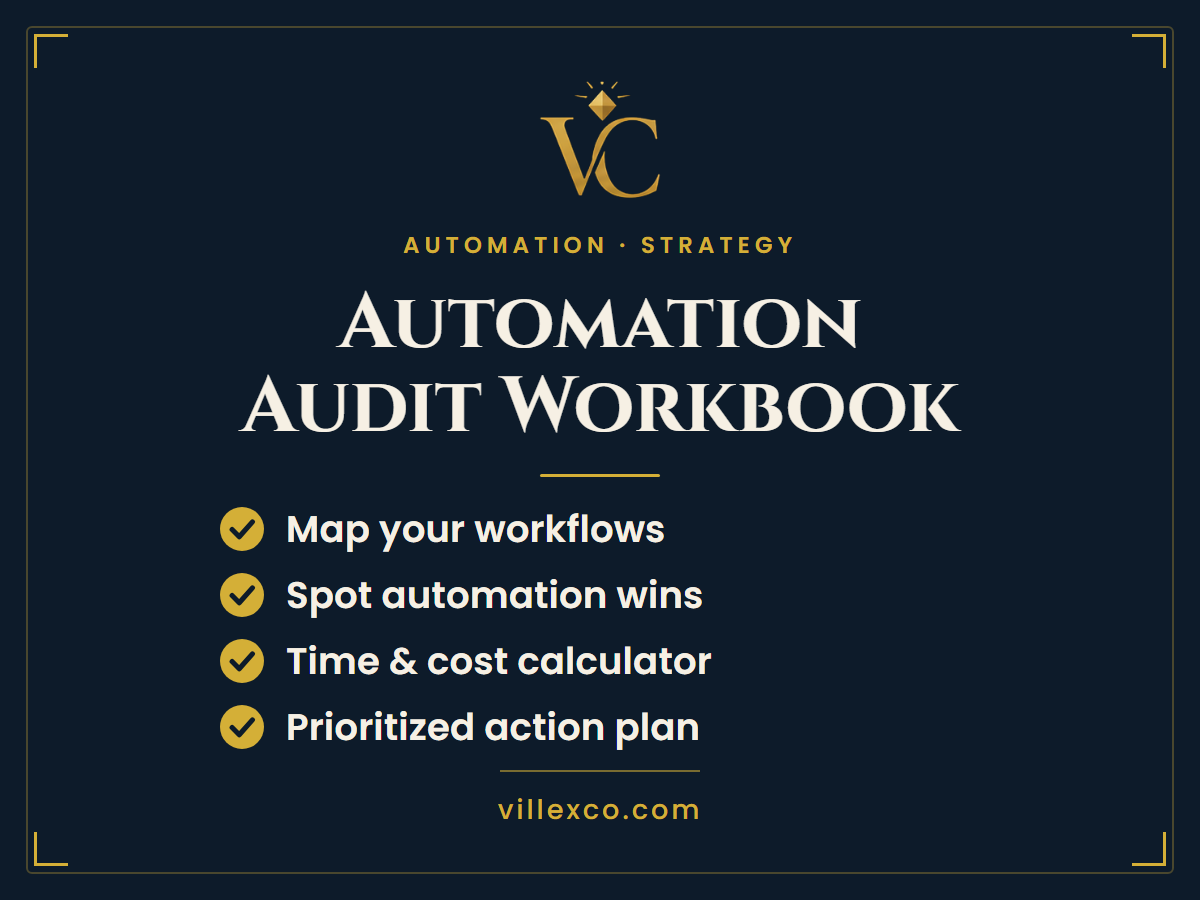
Automation Audit Workbook
An audit workbook that walks you through every repeat task in your business so you know exactly what to automate first, and what to leave alone.
Want updates like this in your inbox?
One short note a month with the tool we'd reach for in your situation. Free starter kit included on signup.