
A business loan application is one of those tasks that takes ten hours if you have the documents ready and ten weeks if you do not. The difference is not the lender’s pace, it is whether the documents exist, are current, and are organized. Most owners learn this the hard way: they apply on the deadline, get a 22-item document request from the underwriter, and spend the next month chasing tax returns and reconciling P&Ls.
The list below is what SBA-backed lenders and community banks actually request in the first round. Gather these before you apply. Keep them current. When the opportunity comes, equipment finance, a working capital line, an SBA 7(a), the response time is hours, not weeks.
This is not legal or financial advice. Every lender’s package is slightly different, and a few categories of loans (real estate, USDA, specialty industry) ask for more. The list below is the floor.
Why capital readiness matters even if you are not borrowing today
Two reasons.
First, opportunities are time-bounded. Equipment goes on sale. A competitor’s customer base becomes available. A real estate window opens. The owners who get capital fast win those windows. Owners who need eight weeks of document chasing watch them close.
Second, readiness reveals problems while they are small. Many owners assume their books are in order until a lender asks for three years of P&Ls and the reality lands. The earlier the reality lands, the cheaper the fix.
The 12 documents lenders actually ask for
1. Last three years of business tax returns
Form 1120 (C-corp), 1120-S (S-corp), 1065 (partnership), or Schedule C (sole prop) for the last three completed tax years. PDFs, signed.
If the most recent year has not been filed yet, lenders will accept the prior two years plus a current-year estimated P&L, but they will note the missing year and ask for it once filed.
2. Last three years of personal tax returns
Form 1040 for every owner with 20 percent or more equity. PDFs, signed, with all schedules attached. SBA loans require these even for relatively small ownership stakes; some commercial lenders are more flexible.
3. Year-to-date Profit and Loss statement
Current year, through the most recent closed month. Lenders prefer a P&L generated from accounting software (QuickBooks, Xero, NetSuite) rather than a spreadsheet, the software-generated version is harder to fudge and easier to verify.
4. Year-to-date Balance Sheet
Same date as the P&L. Lists assets, liabilities, and equity. The balance sheet is how the lender verifies the business has assets to lend against and that liabilities are within range of the business’s earning capacity.
5. Bank statements (last 12 months)
All business operating accounts. Twelve consecutive months. The lender uses these to verify cash flow, check for overdrafts, and confirm the deposits reconcile with the P&L revenue line.
This is the document most often missing or incomplete. Pull each month directly from the bank’s online portal as a PDF.
6. Accounts Receivable Aging report
Current. Lists every customer who owes money, with amounts and ageing buckets (0-30 days, 31-60, 61-90, 90+). A clean AR aging is a strong signal of operational health.
A business with most receivables aged over 60 days is a red flag for cash flow. Address the AR before applying if possible.
7. Accounts Payable Aging report
Mirror of the AR aging, every vendor you owe money to, ageing buckets. Lenders use this with AR to compute working capital.
8. Debt schedule
A simple table listing every outstanding business debt: lender name, original loan amount, current balance, interest rate, monthly payment, maturity date, collateral. This includes any SBA loan, line of credit, equipment finance, and credit-card balance you treat as business debt.
Most business owners have never compiled this. The first time is the hardest. Update it quarterly once you have it.
9. Personal financial statement
A list of personal assets (real estate, vehicles, investments, retirement accounts, cash) and personal liabilities (mortgage, credit cards, auto loans, personal loans). SBA Form 413 is the standard format and lenders typically request it specifically.
For every owner with 20 percent or more equity.
10. Business formation documents
Articles of incorporation or organization, operating agreement, EIN letter from the IRS, state business registration. Lenders verify the entity exists, who owns it, and how it is structured.
If any of these are missing, get them now. The Florida Department of State Division of Corporations (Sunbiz) and the IRS both have online tools to retrieve lost documents.
11. Business plan or use-of-funds narrative
A one to three page document describing what the loan will be used for, how it will be repaid, and how the business operates. SBA loans require a more formal business plan; commercial loans often accept a shorter use-of-funds narrative.
Write this once. Update it for each application.
12. Industry-specific licenses or certifications
If your business requires a state license (contractor’s license, real estate license, professional license), the current copy. If you hold any industry certifications relevant to the loan purpose, copies.
The 12-item quick reference
- Last 3 years of business tax returns
- Last 3 years of personal tax returns (all owners ≥ 20%)
- Year-to-date P&L from accounting software
- Year-to-date Balance Sheet
- Last 12 months of business bank statements
- Current Accounts Receivable Aging
- Current Accounts Payable Aging
- Debt schedule (every outstanding business loan)
- Personal Financial Statement (SBA Form 413)
- Business formation documents (articles, operating agreement, EIN)
- Business plan or use-of-funds narrative
- Industry-specific licenses or certifications
How to organize the package
Create a folder structure on your storage of choice (OneDrive, Drive, Dropbox) named “Capital Readiness [YYYY-Q1].” Subfolder per category from the list above. Refresh each subfolder quarterly.
When a lender asks for documents, share a read-only link to the relevant subfolders. Do not email PDFs attachment by attachment, it slows the lender’s processing and increases the chance of version confusion.
What lenders are actually evaluating
Behind every document request is a question.
- Cash flow: Does the business generate enough cash to service the proposed debt? Lenders compute Debt Service Coverage Ratio (DSCR): annual net operating income divided by annual debt service. They want at least 1.25; some require 1.5.
- Credit history: Personal and business credit reports. Lenders pull these directly; you do not provide them, but you should know your scores before applying.
- Collateral: Is there an asset to secure the loan against (equipment, real estate, inventory, receivables)?
- Owner equity stake: Owners with more equity in the business are seen as more committed. Lenders often want to see owner-contributed capital as a percentage of total project cost.
- Industry stability: Some industries are easier to finance (HVAC, plumbing, accounting) than others (restaurants, retail, gig economy). The industry affects which lenders are willing to work with you.
A capital-ready owner knows the answers to these five questions before applying. They are not surprised by the underwriter’s analysis because they have done their own.
The lender shortlist for service-business owners
Three lender categories worth knowing.
SBA-backed lenders. The SBA does not lend directly; they guarantee loans made by approved banks. SBA 7(a) is the most common product, up to $5 million, terms up to 25 years for real estate, up to 10 for equipment, up to 7 for working capital. Application is more paperwork-heavy than commercial alternatives but pricing is favorable.
Community banks and credit unions. Local relationships, faster decisions on smaller amounts, more willing to work with newer businesses. Often the right starting point for a first business loan.
Online lenders (Bluevine, Fundbox, Kabbage where it still exists). Faster, more expensive, less paperwork. Good for short-term working capital. Bad for long-term financing.
Match the lender to the loan purpose. Do not start with the online lender for a 10-year equipment loan; do not start with the SBA for a 90-day cash bridge.
Get your books in shape before the lender asks
Items 3 through 9 on the list above, the P&L, the balance sheet, the reconciled bank activity, all start with books a lender can trust. The Villex Co Bookkeeping Starter Kit for $37 is the foundation: a 10-section setup guide (including the 8 QuickBooks Online settings most new users skip), a pre-built chart of accounts you import into QuickBooks Online, a month-end close checklist, and an income and expense tracker that works in Excel or Google Sheets. It will not file your loan application, but it gets the financial documents in order so the day a lender asks, your numbers are current and clean. Formats: PDF, CSV, and Excel .xlsx, instant download.
One practical post for service-business owners every two weeks. Subscribe to the newsletter →
Results will vary. For educational and organizational purposes only. Not legal, tax, accounting, investment, or lending advice. Not affiliated with, endorsed by, or approved by the SBA. “SBA” is a trademark of the U.S. Small Business Administration. Consult a licensed lender or financial advisor for guidance specific to your situation. © 2026 Villex Entreprises LLC.
The tool that does this for you
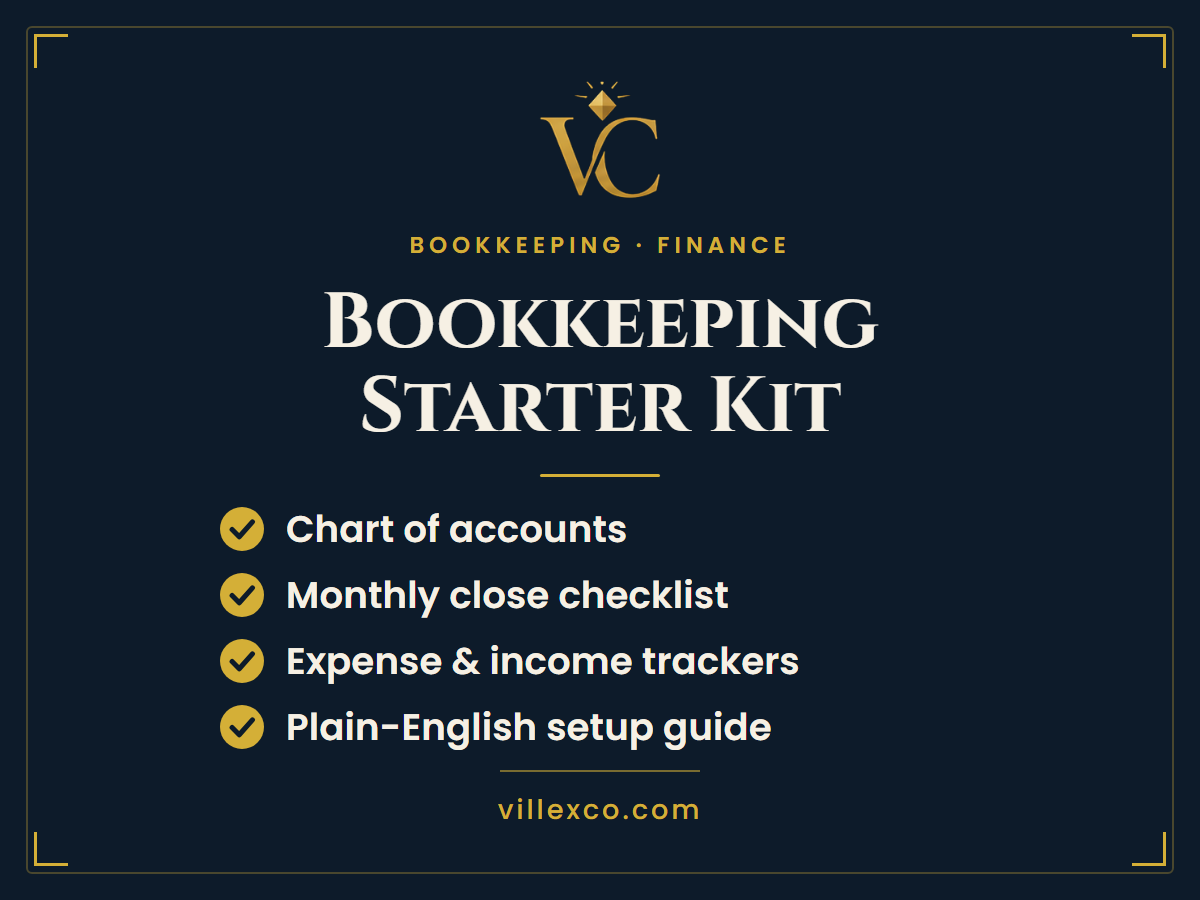
Bookkeeping Starter Kit
A starter kit for new business owners who keep finances in their head, chart of accounts, expense tracker, and month-end close checklist.
Want updates like this in your inbox?
One short note a month with the tool we'd reach for in your situation. Free starter kit included on signup.